Angama Mara
On the Oloololo Escarpment rim, on private land immediately outside the Mara Triangle sector of Maasai Mara National Reserve, with a direct descent road into the reserve.
A dedicated Mara-only itinerary built entirely around positioning you at the Great Migration's dramatic river crossings.
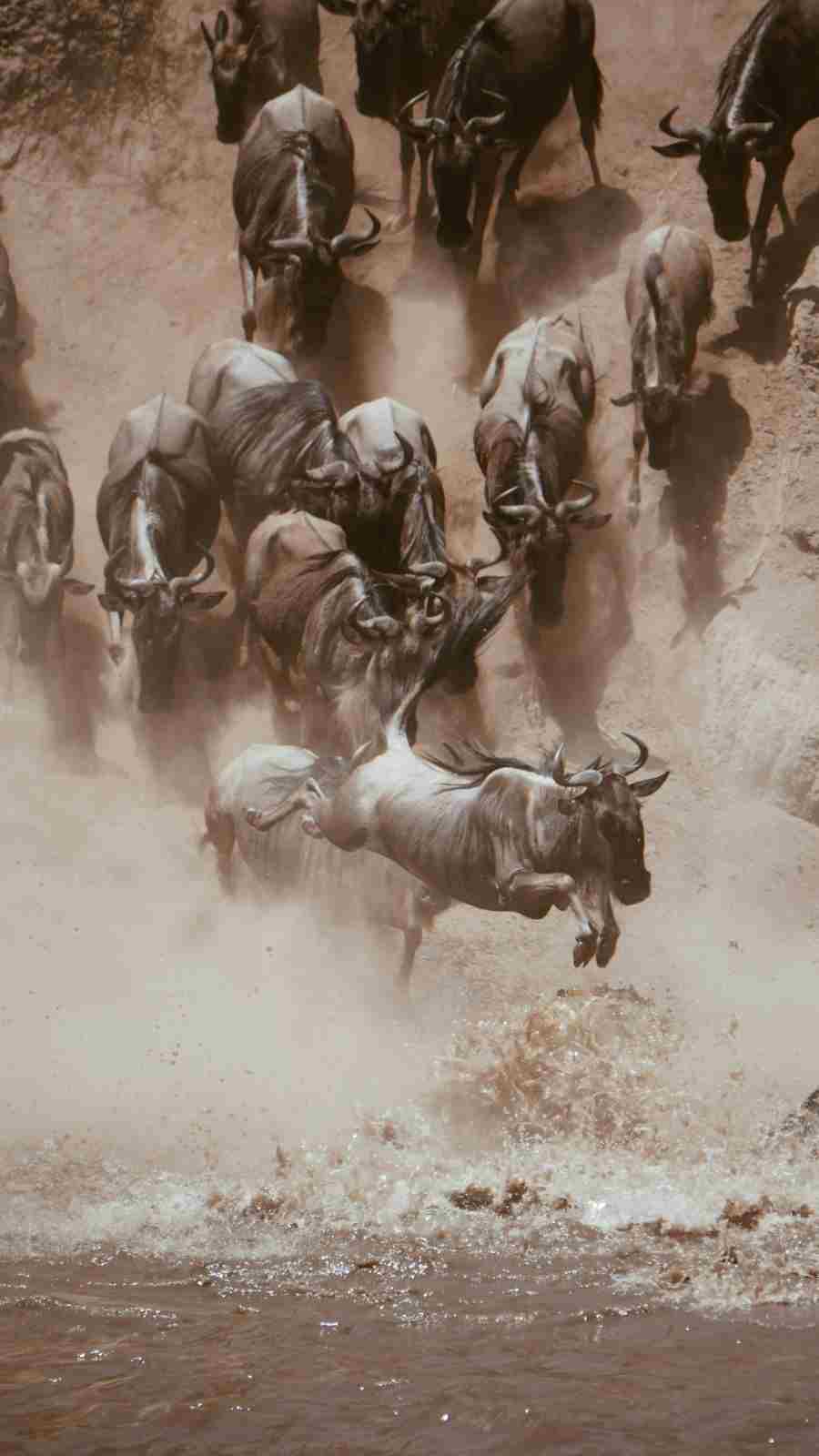
For travelers who already know the Mara and want one single-minded objective, this eight-day itinerary strips away everything but the Great Migration's river crossings — the most viscerally dramatic set-piece in African wildlife, where up to 1.5 million wildebeest and several hundred thousand zebra commit, herd by herd, into water where Nile crocodiles have waited motionless for days. Rather than one or two crossing attempts squeezed into a broader multi-country trip, this route dedicates a full eight nights entirely to the Mara ecosystem, moving through three distinct sectors — the Mara Triangle's most active crossing points, the resident big-cat territory of central Mara, and the off-road freedom of Mara North Conservancy — so your guide can chase real-time herd movement rather than a fixed schedule. This is a photography- and migration-focused itinerary built for guests who want depth over breadth.
Timing genuinely matters here, and we brief every guest honestly on it: the Mara River crossings cluster most reliably between late July and early October, when the migration's northward push from the Serengeti reaches peak density along the river's western bank, though exact crossing days are never guaranteed and can happen at any hour. What changes across the ecosystem's three sectors is access — the Mara Triangle, managed independently by the Mara Conservancy, sees markedly lower vehicle density at its crossing points than the main reserve, while Mara North's conservancy status permits off-road driving and night game drives forbidden inside the national reserve itself. Spreading your nights across all three, as this route does, meaningfully increases your odds of a genuine, unhurried crossing sighting rather than one shared with forty other vehicles.
This itinerary can be shortened, extended, or combined with any other route in our library — including a Zanzibar or Seychelles finale on our multi-country templates, or paired directly with our signature Kenya Migration & Zanzibar Escape for an even more customized journey.
The Mara River's most active crossing points, with early-morning positioning.
Resident big-cat prides and open-plains game drives.
A private conservancy stretch with off-road driving privileges.
A short domestic flight from Nairobi's Wilson Airport crosses the Rift Valley's escarpment wall and delivers you into the Mara Triangle — the western sector of the Maasai Mara ecosystem, bounded by the Mara River and independently managed by the Mara Conservancy, which caps vehicle numbers more strictly than the main reserve. Met at the airstrip by your dedicated guide, you're driven directly toward the river to scout current crossing activity before check-in, since herd positioning can shift within hours. The Oloololo Escarpment rises dramatically to the west, and your guide will use this afternoon to brief you on how the crossing-point network is read day to day — hesitant herds gathering at the bank, dust clouds signaling approach, and the radio network of spotter guides your team taps into.
A full day dedicated to the Mara Triangle's most active crossing points — Lookout Hill, the Cul-de-Sac and Purungat Bridge among them — where steep, eroded banks funnel the herd's momentum into moments of genuine mass hesitation before commitment. Your guide positions the vehicle upwind and at a respectful distance, reading behavioral cues (lead animals pacing the bank, dust rising from the approaching column) that typically precede a crossing by anywhere from minutes to hours. Between attempts, the surrounding plains hold resident lion prides that have learned to intercept disoriented wildebeest at the crossing's far bank, along with spotted hyena clans working the margins for injured stragglers — the crossing's aftermath is, in its own way, as compelling as the event itself.
Your second full day in the Triangle allows for a genuinely patient approach — returning to yesterday's most promising crossing points at first light, when overnight herd movement often positions large columns close to the bank before the heat of the day builds. For early risers, an optional sunrise hot air balloon safari drifts silently above the plains as the crossing points come into view from above, a genuinely different vantage on the same landscape, followed by a traditional bush breakfast set up in open grassland. The afternoon closes your Triangle stay with a final drive along the river's western bank and a sundowner on the escarpment rim, the Mara's characteristic burnt-orange sky settling over the plains below.
A scenic game drive transfer east brings you into the central sector of the Maasai Mara National Reserve, crossing the Musiara Marsh area on the way to your camp — reached, in a genuinely distinctive touch, by a short boat crossing over the Mara River itself rather than a vehicle bridge. This stretch of the reserve is famous among wildlife researchers as the territory of the long-studied 'Marsh Pride,' whose multi-generational history has been documented for decades by wildlife filmmakers. Your afternoon game drive focuses on this pride's current territory along the marsh edge, alongside dense herds of topi and buffalo that graze the permanently green wetland margin even in the dry season.
A full day working the central reserve's resident predator populations, beginning with the Marsh Pride's territory before pushing south toward the Talek River, whose gallery forest and steep banks support both a separate resident lion pride and some of the Mara's most consistent leopard sightings, individual cats often found draped along low branches through the heat of midday. This central sector also sits directly in the migration's grazing path once herds have crossed, meaning wildebeest and zebra columns are frequently visible moving across open grassland between crossing attempts elsewhere. A relaxed afternoon game drive closes the day, your guide adjusting the route based on that morning's radio reports from guides working the wider ecosystem.
Today's transfer carries you north out of the national reserve boundary into Mara North Conservancy, a community-owned wildlife corridor where a strict cap on bed numbers keeps guest density dramatically lower than the main reserve, even during peak migration season. Because this is private conservancy land rather than government reserve, your afternoon game drive can go off-road to follow specific animals — a real practical advantage when tracking a hunting cheetah or a leopard moving through thick cover, neither of which reserve rules would allow you to follow closely. Settling into camp along the conservancy's riverbank, the pace deliberately slows after two intense days of crossing pursuit.
A full day in Mara North Conservancy's varied terrain of open grassland, riverine forest and low rocky outcrops, tracking resident cheetah, leopard and lion prides at close range with the freedom of off-road access. Your guide's conservancy-specific knowledge of favored denning sites and hunting grounds, built through daily radio contact with fellow conservancy guides, typically delivers sightings impossible to arrange inside the national reserve. As dusk falls, an after-dark game drive — another conservancy-exclusive privilege — opens up Mara North's nocturnal species: genet, civet, spotted hyena on the move, and, with good fortune, a hunting leopard using the cover of darkness. A final dinner under the stars closes your Mara immersion.
A final relaxed morning allows for one last game drive around camp or a slow breakfast on the deck before your light-aircraft transfer back to Nairobi's Wilson Airport, connecting with onward or international departures. Our team remains available throughout this final leg, and given how many of our guests return specifically to chase a better crossing, we're always glad to start planning your next Mara season early.
Entire week dedicated to a single ecosystem for maximum crossing odds
Migration-specialist guide with a real-time spotter network
Private conservancy days with off-road access included
Ideal for repeat Kenya visitors chasing the definitive crossing shot
On the Oloololo Escarpment rim, on private land immediately outside the Mara Triangle sector of Maasai Mara National Reserve, with a direct descent road into the reserve.
Located within Maasai Mara National Reserve, on the Musiara Marsh side reached by a short boat crossing.
Inside Mara North Conservancy, a community-owned wildlife corridor bordering Maasai Mara National Reserve.
| Accommodation Tier | Per Person Sharing (USD) | Single Supplement |
|---|---|---|
| Classic Comfort | $6,100 | +$1,050 |
| Premium | $7,900 | +$1,350 |
| Ultra-Luxury | $10,050 | +$1,750 |
Rates are per person sharing, in USD, based on double occupancy during peak migration season (late July to early October); contact us for shoulder-season pricing and single-traveler rates.
July through September consistently offers the highest crossing frequency, though exact timing varies year to year with rainfall patterns.
Not in the national reserve itself, but the private conservancies included in this route permit off-road access for better positioning.
Kenya's two most iconic parks in one efficient week: the Mara's open plains and Amboseli's elephant herds bene…
Kenya's wild north — rare desert-adapted species, community conservancies, and some of the country's finest wa…
Kenya's best wildlife paired with a relaxed Diani Beach finale on the Indian Ocean coast — no international be…